
Why Good Policies Fail Without Strong Institutions
Wed, 28 Oct 2026
Follow the stories of academics and their research expeditions
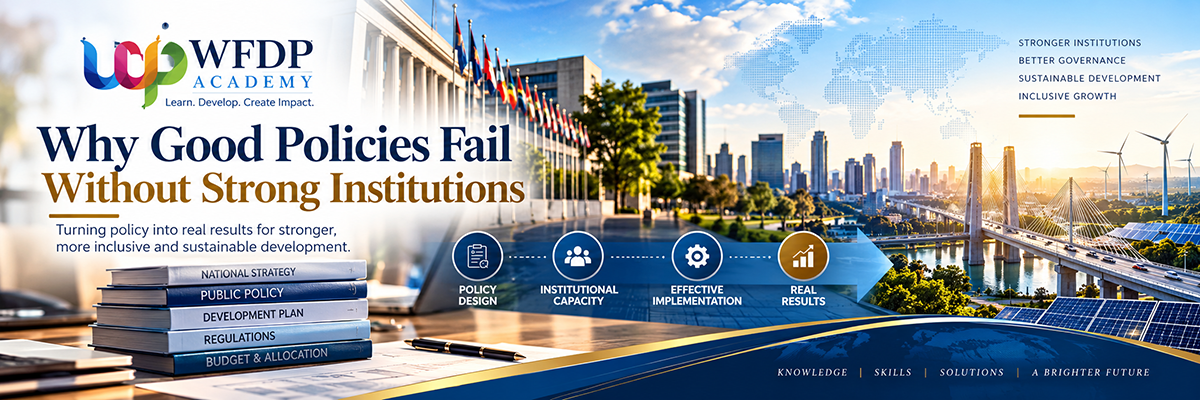
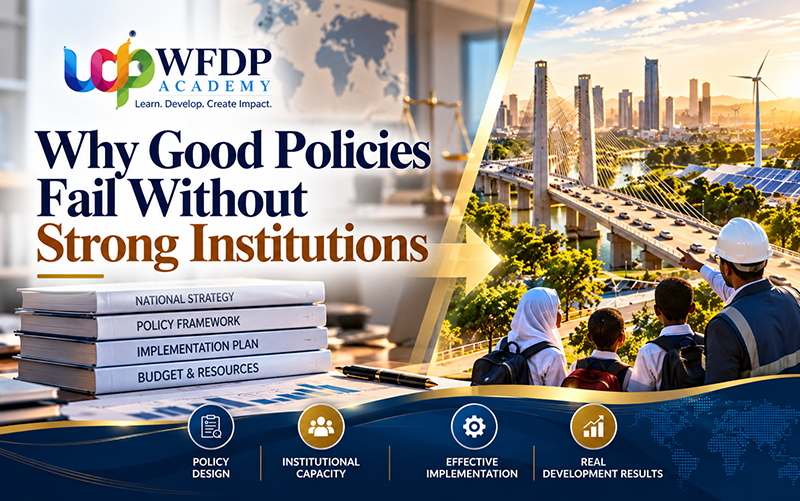
Every year, governments introduce new strategies, announce development programs, and establish ambitious national objectives.
Some initiatives achieve measurable results. Others struggle to move beyond official announcements, despite having clear objectives, political support, and substantial financial commitments.
Why does this happen?
The answer often lies not in the quality of the policy itself, but in the capacity of the institutions responsible for implementing it.
A policy can be well designed and still fail if the institutions expected to deliver it lack the necessary authority, coordination, resources, or accountability.
Understanding this distinction is essential for students, public officials, development professionals, and anyone interested in how governments and institutions translate decisions into results.
Public policy establishes what governments intend to achieve.
Implementation determines whether those intentions produce meaningful results.
Consider a government that announces a national strategy to improve education.
The strategy may include building schools, training teachers, modernizing curricula, and expanding access to digital learning.
However, implementation requires much more than adopting the strategy.
Government departments must coordinate responsibilities. Budgets must be allocated and managed. Procurement procedures must function effectively. Teachers must receive appropriate training. Schools must have the infrastructure and resources necessary to operate.
Without these institutional capabilities, even a carefully designed education policy may produce disappointing outcomes.
The same principle applies to healthcare, infrastructure, environmental protection, digital transformation, and economic development.
Effective development requires both sound policies and institutions capable of carrying them out.
An effective institution is not necessarily the institution with the largest budget or the greatest number of employees.
Institutional effectiveness depends on several interconnected factors.
Organizations need clearly defined mandates, decision-making authority, and operational responsibilities.
When multiple institutions share responsibilities without adequate coordination, duplication and delays can undermine implementation.
Institutions require personnel with appropriate knowledge, technical competencies, and management skills.
Continuous professional development helps employees adapt to new technologies, regulatory requirements, and emerging challenges.
Clear reporting mechanisms, financial controls, and performance monitoring strengthen institutional accountability.
Transparency can also support public confidence by making institutional decisions and results easier to understand.
Many development challenges involve several ministries, public agencies, local authorities, and external partners.
Effective coordination helps ensure that their activities contribute to shared objectives rather than operating independently.
Institutional performance depends on continuity.
Development programs often require implementation periods extending beyond annual budgets or political cycles.
Long-term planning and effective administrative systems can help sustain progress.
These elements form the foundation of institutional capacity.
Institutional performance has direct implications for economic development.
Investors and businesses depend on predictable procedures, reliable public services, and consistent implementation of applicable rules.
When administrative processes are unclear or inefficient, economic activity may become more costly and uncertain.
For example, delays in permits, inconsistent regulatory procedures, and inadequate infrastructure coordination can discourage investment.
Conversely, effective institutions can improve the environment for entrepreneurship, innovation, and economic growth.
Institutional capacity also influences how efficiently public resources are used.
A government may allocate significant funding to infrastructure development, but the quality of procurement, project management, supervision, and maintenance will influence the actual results.
The central issue is therefore not only how much governments spend, but how effectively institutions transform available resources into public value.
The United Nations 2030 Agenda recognizes the importance of effective institutions.
Sustainable Development Goal 16 promotes peaceful and inclusive societies, access to justice, and effective, accountable, and inclusive institutions.
Institutional effectiveness also supports progress across the other Sustainable Development Goals.
For example:
These relationships demonstrate that institutional development is not an isolated governance issue.
It is a fundamental component of sustainable development.
International cooperation can provide important resources, expertise, technology, and technical assistance.
However, external support cannot permanently substitute for effective national institutions.
A development project may benefit from international financing and technical expertise during its initial implementation.
Yet its long-term sustainability often depends on whether national and local institutions can operate, maintain, and manage the resulting services.
Consider an internationally supported water infrastructure project.
Constructing the infrastructure is an important achievement.
But sustainable results also require maintenance systems, trained personnel, financial planning, regulatory oversight, and community engagement.
Without these capabilities, the project’s benefits may decline over time.
This is why capacity development and national ownership are important principles of international development cooperation.
External partnerships are most valuable when they strengthen the ability of institutions to deliver results independently and sustainably.
Institutions must continuously learn.
Economic conditions change. Technologies evolve. Public expectations increase. New challenges require different approaches.
An institution that relies exclusively on established procedures may struggle to respond effectively to emerging circumstances.
Institutional learning involves developing professional competencies, evaluating performance, sharing knowledge, and improving administrative processes.
Education and training contribute directly to this process.
For public officials, understanding governance principles can improve decision-making.
For development professionals, project planning and evaluation skills can strengthen implementation.
For institutional leaders, knowledge of strategic management and accountability can support organizational effectiveness.
Capacity development should therefore be viewed as a continuing institutional responsibility rather than an occasional training activity.
Institutional reform is often discussed in broad terms.
However, meaningful improvement requires practical measures.
A government seeking to strengthen a public institution might begin by assessing its current responsibilities, resources, and performance.
The assessment could identify weaknesses in administrative procedures, coordination, staff capabilities, or monitoring systems.
An improvement plan could then establish specific objectives, responsibilities, timelines, and measurable indicators.
For example, a public agency responsible for business registration might aim to reduce processing delays.
Its reform program could include staff training, simplified procedures, digital services, and improved coordination with other authorities.
Progress could be measured through processing times, service accessibility, administrative costs, and user satisfaction.
This approach connects institutional reform with measurable public outcomes.
It also demonstrates why implementation capacity matters as much as policy design.
Understanding institutions is essential for anyone preparing to work in government, international organizations, development agencies, or the private sector.
Future leaders should recognize that institutions operate within legal, political, economic, and social environments.
Effective decision-making therefore requires more than technical expertise.
It requires an understanding of governance, accountability, organizational responsibilities, resource management, and stakeholder coordination.
Students should also learn to distinguish between activities and outcomes.
Holding a training workshop is an activity.
Improving employees’ professional capabilities is a potential outcome.
Strengthening institutional performance is a broader objective that must be evaluated through appropriate evidence.
This distinction helps professionals focus on meaningful results rather than simply reporting completed activities.
WFDP Academy recognizes the importance of connecting education with institutional and development challenges.
Through its educational activities, the Academy seeks to strengthen understanding of sustainable development, governance, international cooperation, leadership, and related subjects.
Our approach encourages learners to examine how international principles and development frameworks relate to practical challenges faced by governments, organizations, and communities.
By making foundational knowledge more accessible, WFDP Academy aims to contribute to the development of informed professionals who understand both the opportunities and responsibilities associated with institutional development.
Education alone cannot guarantee effective governance.
However, informed decision-making and professional competence are important foundations for institutional improvement.
Governments and institutions will continue to establish ambitious development objectives.
International organizations will continue to promote cooperation, technical assistance, and sustainable development.
Yet the effectiveness of these efforts will ultimately depend on implementation.
Strong institutions provide the organizational capacity necessary to transform policies into services, investments into results, and development commitments into meaningful progress.
The true measure of a development policy is not the ambition of its announcement, but the effectiveness of its implementation.
For students and professionals preparing to contribute to the future of governance and development, understanding institutional capacity is therefore an essential part of their education.
At WFDP Academy, we believe that strengthening knowledge is an important step toward strengthening institutions.
WFDP Academy
Learn. Develop. Create Impact.
Wed, 28 Oct 2026
Wed, 28 Oct 2026
Leave a comment