
Why Good Policies Fail Without Strong Institutions
Wed, 28 Oct 2026
Follow the stories of academics and their research expeditions
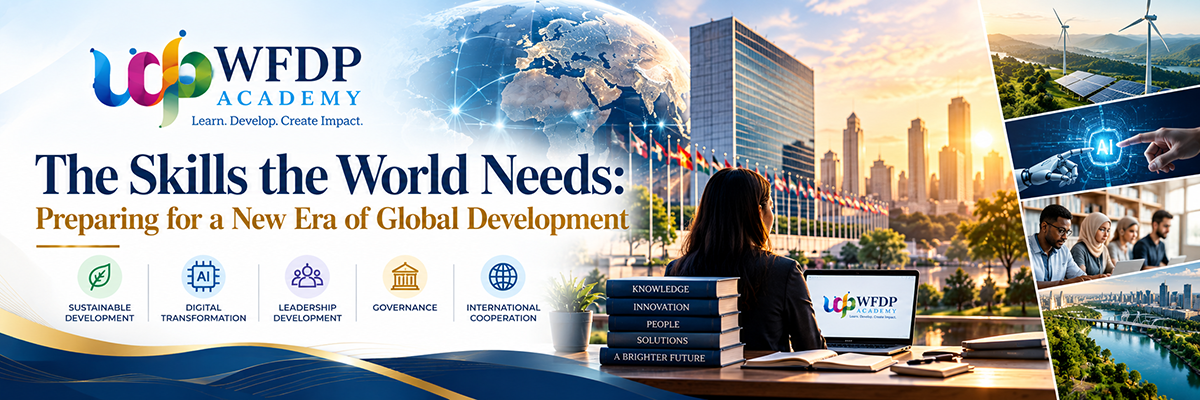
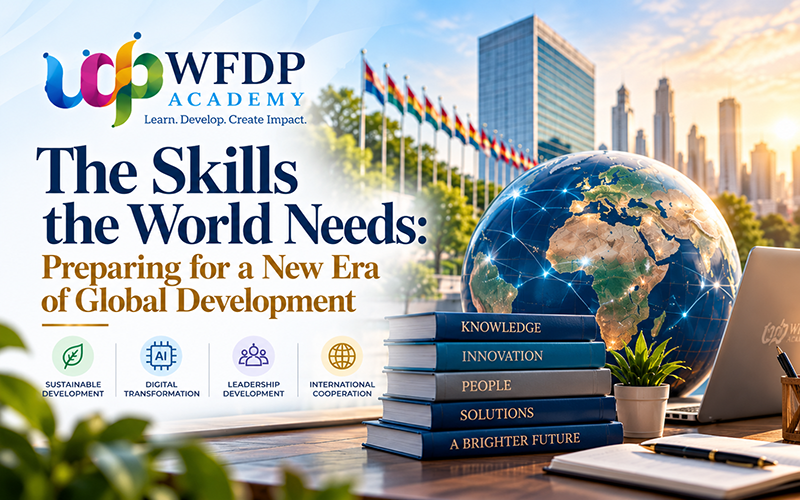
The world is changing faster than traditional education and professional training systems can always respond.
Artificial intelligence is transforming industries. Climate change is reshaping economic priorities. Governments are confronting increasingly complex development challenges, while international cooperation is becoming essential to addressing issues that extend beyond national borders.
These transformations raise an important question:
Are we developing the knowledge and skills needed to respond to the challenges of tomorrow?
At WFDP Academy, we believe that preparing individuals for the future requires more than acquiring technical qualifications. It requires understanding how economic, political, technological, environmental, and institutional developments interact.
Education must help people understand change, respond to uncertainty, and contribute to practical solutions.
For decades, education has largely followed a familiar model: individuals acquire knowledge, obtain qualifications, and apply what they have learned throughout their professional lives.
Today, that model is no longer sufficient on its own.
Technological advances, changing labor markets, economic uncertainty, and global development challenges require continuous learning.
Professionals increasingly need to update their knowledge, develop new competencies, and understand developments beyond their immediate fields of specialization.
A government official working on economic policy may need to understand digital transformation and climate resilience.
An entrepreneur may need knowledge of sustainable business practices, international markets, and emerging technologies.
A development professional may need stronger capabilities in project planning, governance, institutional coordination, and impact assessment.
The ability to connect knowledge across disciplines is becoming increasingly valuable.
The future belongs not simply to those who possess information, but to those who can understand, evaluate, and apply it effectively.
Although professional requirements vary across industries and countries, several areas of knowledge are becoming particularly important.
Understanding sustainable development is increasingly relevant to public policy, business strategy, institutional planning, and international cooperation.
The United Nations Sustainable Development Goals provide a framework for examining the relationships between economic growth, social inclusion, environmental protection, and effective institutions.
Knowledge of these relationships helps individuals recognize that development challenges rarely exist in isolation.
For example, improving education can contribute to employment opportunities, economic productivity, and reduced inequality.
Similarly, expanding access to clean energy can support economic activity while contributing to environmental sustainability.
Digital technologies are changing how governments deliver services, businesses operate, and individuals access information.
Artificial intelligence, data analysis, cybersecurity, and digital governance are becoming important subjects across professional sectors.
However, technological knowledge must be accompanied by an understanding of ethics, accountability, privacy, and responsible innovation.
The objective should not be to adopt technology simply because it is available, but to understand how it can contribute to better outcomes.
Effective institutions are fundamental to sustainable development.
Governments and organizations require transparent procedures, responsible leadership, sound planning, and effective implementation mechanisms.
Understanding governance helps professionals examine how institutions make decisions, allocate resources, manage risks, and evaluate results.
Strong institutions also contribute to public confidence and the long-term sustainability of development initiatives.
Leadership increasingly requires the ability to navigate uncertainty, coordinate diverse stakeholders, and make informed decisions.
Strategic thinking involves understanding the broader consequences of decisions rather than focusing exclusively on immediate results.
It also requires communication, ethical judgment, adaptability, and the capacity to work across professional and cultural boundaries.
These competencies are relevant not only to senior executives and government officials, but also to students, entrepreneurs, researchers, and emerging professionals.
Economic, environmental, technological, and political developments are increasingly interconnected.
Understanding international institutions, development frameworks, and cross-border cooperation helps individuals recognize how global decisions influence national and local conditions.
International awareness also encourages constructive dialogue and a better understanding of different perspectives.
In a connected world, the ability to cooperate across borders is an important professional capability.
Knowledge becomes particularly valuable when it can be applied.
Understanding a development challenge is an important first step. Identifying appropriate responses requires additional capabilities.
Consider a community experiencing limited access to clean water.
Addressing this challenge may require knowledge of environmental sustainability, public health, infrastructure planning, financing, institutional responsibilities, and community engagement.
No single discipline can provide every answer.
Similarly, improving youth employment may involve education policy, entrepreneurship, investment, digital skills, labor market analysis, and institutional cooperation.
These examples demonstrate why modern education should encourage learners to connect different areas of knowledge.
At WFDP Academy, our educational approach emphasizes the relationship between theoretical understanding and practical development challenges.
We aim to encourage learners to consider how the concepts they study may apply to their countries, institutions, professions, and communities.
Geographic location, professional responsibilities, and financial circumstances can create barriers to learning.
Online education provides opportunities to reduce some of these barriers.
Digital learning platforms can allow students and professionals to access educational resources without relocating or interrupting their existing responsibilities.
Self-paced learning also provides flexibility for individuals with different schedules and levels of experience.
Nevertheless, accessibility must be accompanied by educational quality.
Clear learning objectives, structured lessons, relevant materials, and meaningful assessments remain essential.
WFDP Academy is developing its online educational activities with these principles in mind.
Our objective is to provide accessible learning opportunities that strengthen understanding and support professional and personal development.
As part of its initial educational offerings, WFDP Academy has developed the course:
Introduction to Sustainable Development and the SDGs
The course provides a structured introduction to the principles and international frameworks that shape contemporary sustainable development.
Participants explore:
The course is designed for beginners and does not require previous professional or academic experience in sustainable development.
It is delivered online, in English, and follows a self-paced learning structure.
The introductory course is offered free of charge, reflecting WFDP Academy’s commitment to accessible foundational education.
Participants who satisfy the applicable course completion and assessment requirements may receive a WFDP Academy Certificate of Completion.
The course provides a starting point for individuals seeking to understand the global development agenda and its relevance to contemporary professional and institutional challenges.
Education should not be understood only as preparation for employment.
It is also an investment in stronger institutions, more informed communities, responsible leadership, and sustainable economic development.
When individuals develop the ability to analyze challenges, evaluate information, and make informed decisions, the benefits can extend beyond their personal careers.
Knowledgeable professionals contribute to organizational effectiveness.
Capable public servants strengthen institutional performance.
Informed entrepreneurs identify opportunities for innovation.
Educated communities are better positioned to participate in decisions affecting their futures.
These outcomes demonstrate why learning and capacity development remain central to long-term progress.
The development challenges of the coming decades will require individuals who can work across disciplines, understand international frameworks, and contribute to practical implementation.
They will need technical knowledge, but also critical thinking, ethical judgment, communication skills, and an understanding of institutional responsibilities.
WFDP Academy seeks to contribute to the development of these capabilities through accessible educational programs and opportunities for continuous learning.
As the Academy expands its educational activities, its focus will remain on connecting knowledge with real-world challenges and encouraging responsible professional development.
The future of education is not defined solely by technology, institutions, or qualifications.
It is defined by the ability to prepare individuals to understand and improve the world around them.
At WFDP Academy, we believe that meaningful development begins with informed people who are prepared to turn knowledge into action.
Explore the educational opportunities available through WFDP Academy and discover how knowledge can contribute to your professional development and understanding of global challenges.
WFDP Academy
Learn. Develop. Create Impact.
Wed, 28 Oct 2026
Wed, 28 Oct 2026
Leave a comment